
Greek And Roman Deities On Coins-29
2026-02-16 Mon
In #ancient Greek religion, Dione is known as the Titan Goddess of fertility and prophecy. There are different #stories about her parentage. Some sources say she is the daughter of the #Titans Uranus and Gaia, while others claim she is the child of Titans Oceanus and Tethys. Dione is often called "the temple associate" of #Zeus and was worshipped at Dodona, an ancient #Oracle in northwestern #Greece. This oracle was located in a sacred grove of oaks and was believed to be a place where #Divine #Communication happened. The messages here were often seen as unclear advice or prophecies.The name "Dione" comes from being the feminine form of Zeus (Dios). To learn more about Zeus refer to this link: Greek And Roman Deities On Coins-7. In Homer's "Iliad," Aphrodite is said to be the daughter of Zeus and Dione. However, later works suggest her origins come from sea foam. Dione took on a nurturing #ROLE when she tried to heal her daughter Aphrodite during the Trojan War. For further insights into Aphrodite, please refer to the following link: Greek And Roman Deities On Coins-10. In Hesiod's "Theogony," Dione is shown as one of the main goddesses present at Apollo’s birth, indicating that she may have served as his midwife.
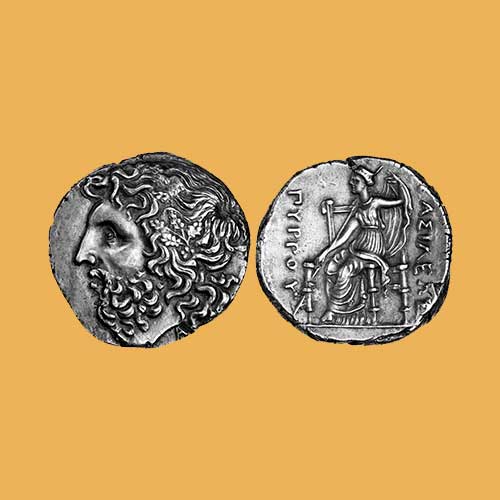
Dione first appeared on #Coins in the 3rd century BCE. The coin featured on this post is a #Silver Tetradrachm of Pyrrhus, dated between 295 BCE and 272 BCE, from Epirus, a region in northwestern Greece known for the sanctuary of Dodona. Weighing 16.82 grams, the obverse of the #COIN shows the head of Zeus with an oak wreath, facing left, with the Greek letter 'A' at the bottom. The reverse showcases Dione seated partly to the front on a #Throne, holding a scepter in her right hand while raising her himation with her left over her shoulder. The himation is a type of garment draped over the left shoulder and wrapped around the body in ancient Greece. A Greek inscription on the coin reads [B]ASILEOS PYRROY, which means #King Pyrrhus.
The idea of a goddess linked to fertility is prominently illustrated in the early coins of the Kushan #Empire. The goddess #NANA, also called Nanaia or Nanashao, represents fertility and #royalty. She is mentioned in the Rabatak inscription of Kanishka, where she is recognized as the deity who granted him his high status. Like Dione, she is depicted holding a scepter that represents shared cultural beliefs.
Latest News
-
Extremely Rare Silver Quarter Tanka of Kachar Monarch Yasho Narayan, Owing Allegiance to Ghatotkacha Lineage
2026-06-23 TueHidden within the misty valleys and forested hills of Northeast India lies the story of the Kacha...
-
Gun and Sword on Silver Katra Taka of Independent Kingdom of Jaintiapur King Bar Gossain II
2026-06-22 MonThe Jaintia was a prominent medieval Independent Kingdom in Northeast India, ruled ...
-
Rare and Beautiful Gold Dinar of Gauda Ruler Shashanka
2026-06-19 FriThe Gauda dynasty was an ancient kingdom in the Gauda region of Bengal. It emerged as an independ...
-
Exceptional Gold Mohur of Ahom King Swargdeo Rajeshwar Singha
2026-06-19 FriThe Ahoms were ethnic group originating from the Tai people and founder of Assamese royal dynasty...
-
Heavy Lead Coin of Hiranyakas, King Khadakama
2026-06-18 ThuThe Hiranyakas were a local dynasty that rose in the mid-3rd century CE, in Rayalaseema region th...